
.svg)

AEO vs SEO in 2026: What You Need to Know
December 22, 2025
•
Justin Kerby
AEO or Agent Engine Optimization is a term used to describe a strategy of getting your content to display in AI search platforms. The world is changing fast, and having an AEO strategy is the way to stay ahead of the curve.
For most of the internet’s history, search worked like this:
You had a problem.
You went looking for answers.
You evaluated options.
You made a decision.
Search engines acted like a directory. You browsed the aisles.
That mental model no longer holds.
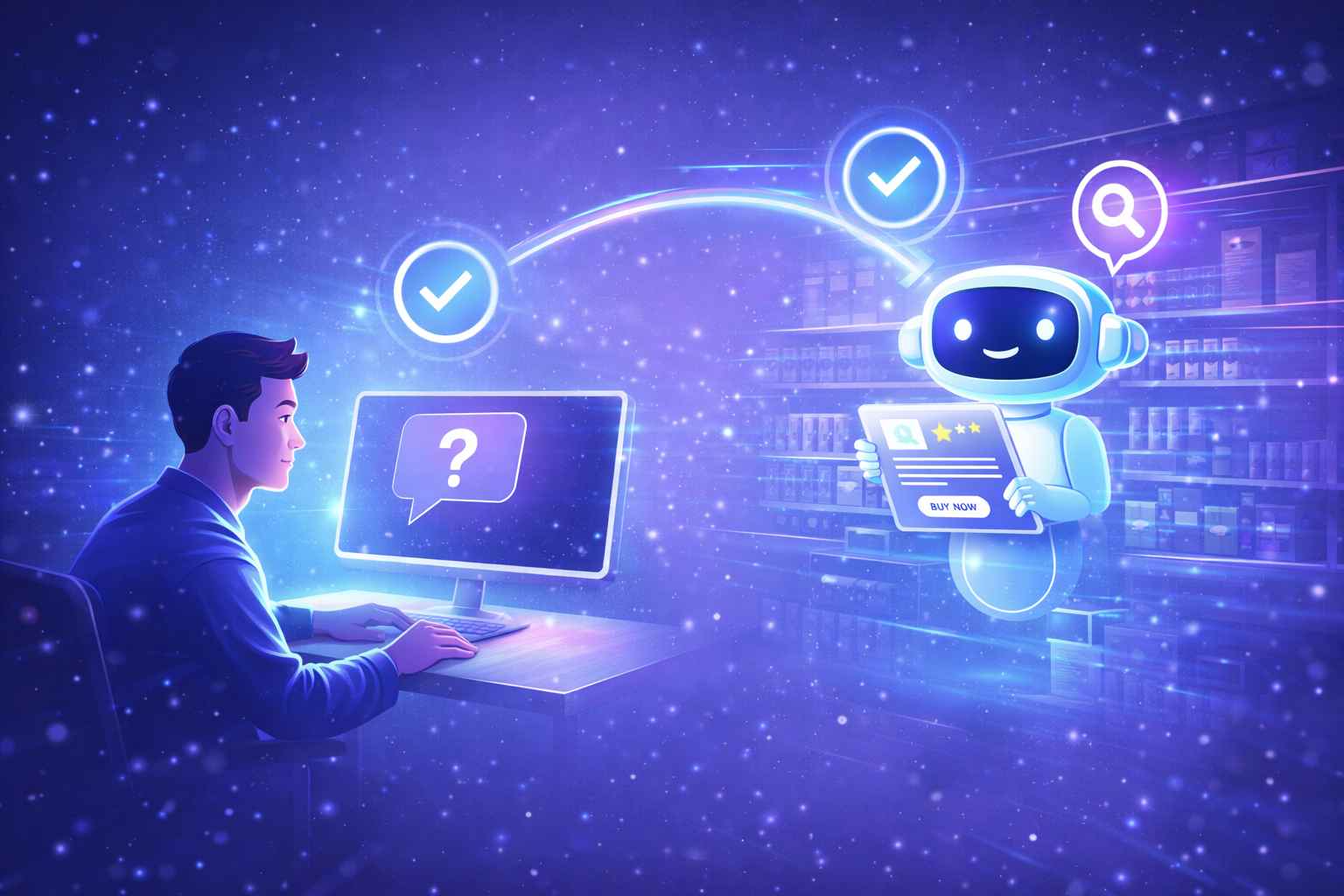
Today, we’re watching a shift from searching to delegating. Humans don’t always go to the store anymore — we send an agent. That agent comes back with an answer, a recommendation, and sometimes a decision already made.
That change is what’s driving the rise of Answer Engine Optimization (AEO).
And while AEO doesn’t replace SEO, it changes how visibility, trust, and conversion work in a meaningful way.
From Search Engines to Answer Engines
Answer engines — tools like ChatGPT, Google AI Overviews, Perplexity, and others — are collapsing the traditional funnel.
What once looked like:
Problem → Search → Compare → Decide → Purchase
Now often looks like:
Problem → AI Answer → Action
In many cases, that entire process takes hours instead of weeks.
From the data we’re seeing, actions taken from AI-driven answers are more valuable on a per-user basis. People move faster. The intent is clearer. The friction is lower.
That said, context matters.
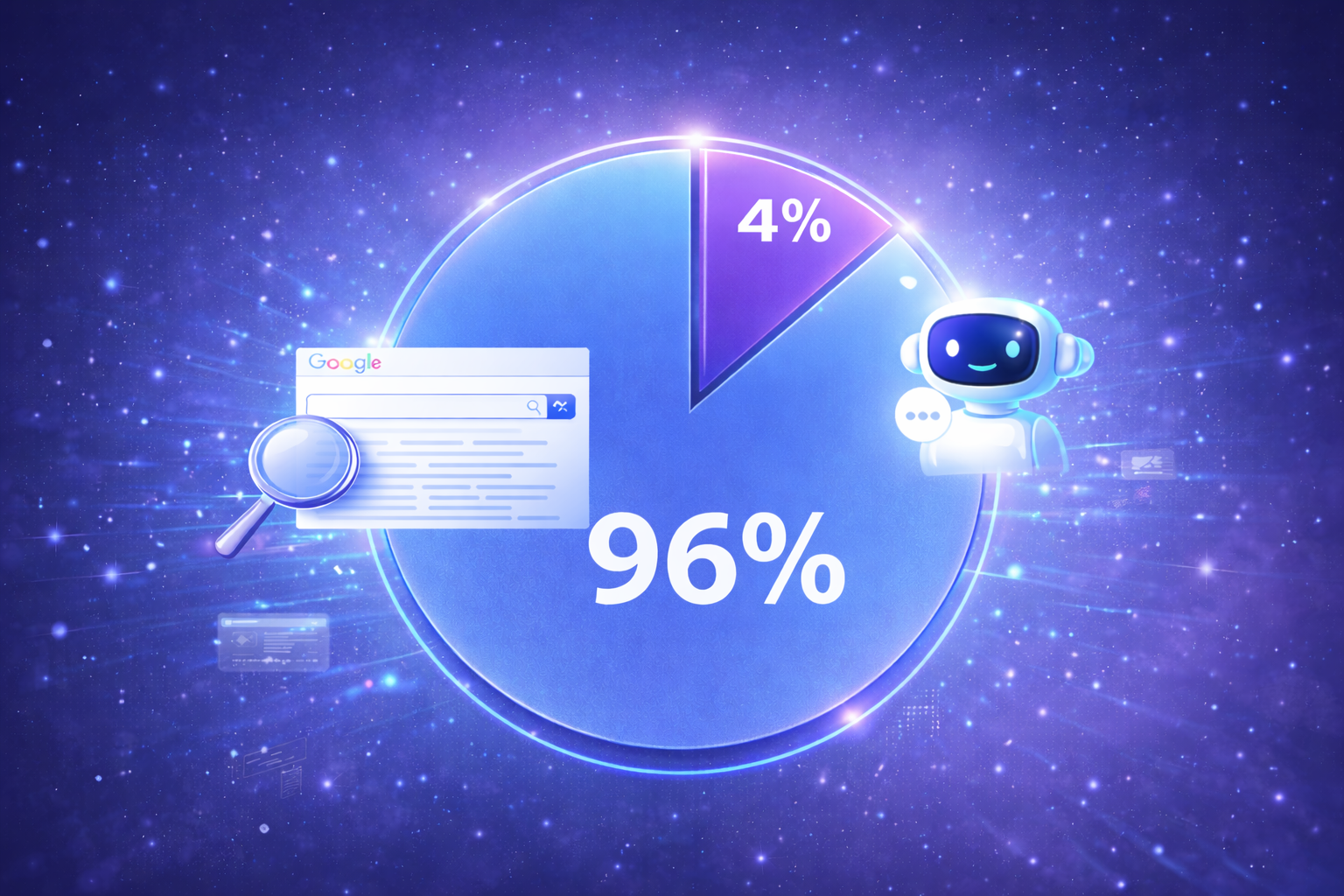
Traditional search still accounts for roughly 96% of total traffic volume today.
That number will decline over time, but it isn’t disappearing tomorrow.
The opportunity isn’t choosing SEO or AEO.
It’s understanding how they work together — and where they differ.
AEO Is Not “Just SEO” (and That’s a Common Mistake)
One of the biggest misconceptions right now is that AEO is simply SEO with a new name.
It isn’t.
Backlinks, referring domains, and authority scores — long considered core SEO signals — are relatively weak predictors of whether a brand gets cited in AI-generated answers. Most studies suggest that backlinks are only predictors of citations in answer engines in the 4-7% range.
The majority of AI citations are driven by other factors, including:
- Content clarity and relevance
- Demonstrated expertise
- Freshness and recency
Good SEO foundations often support strong AEO performance. But they don’t explain most of what’s happening inside answer engines.
How Answer Engines Decide Who Gets Cited
One of the most important things to understand about AEO is this:
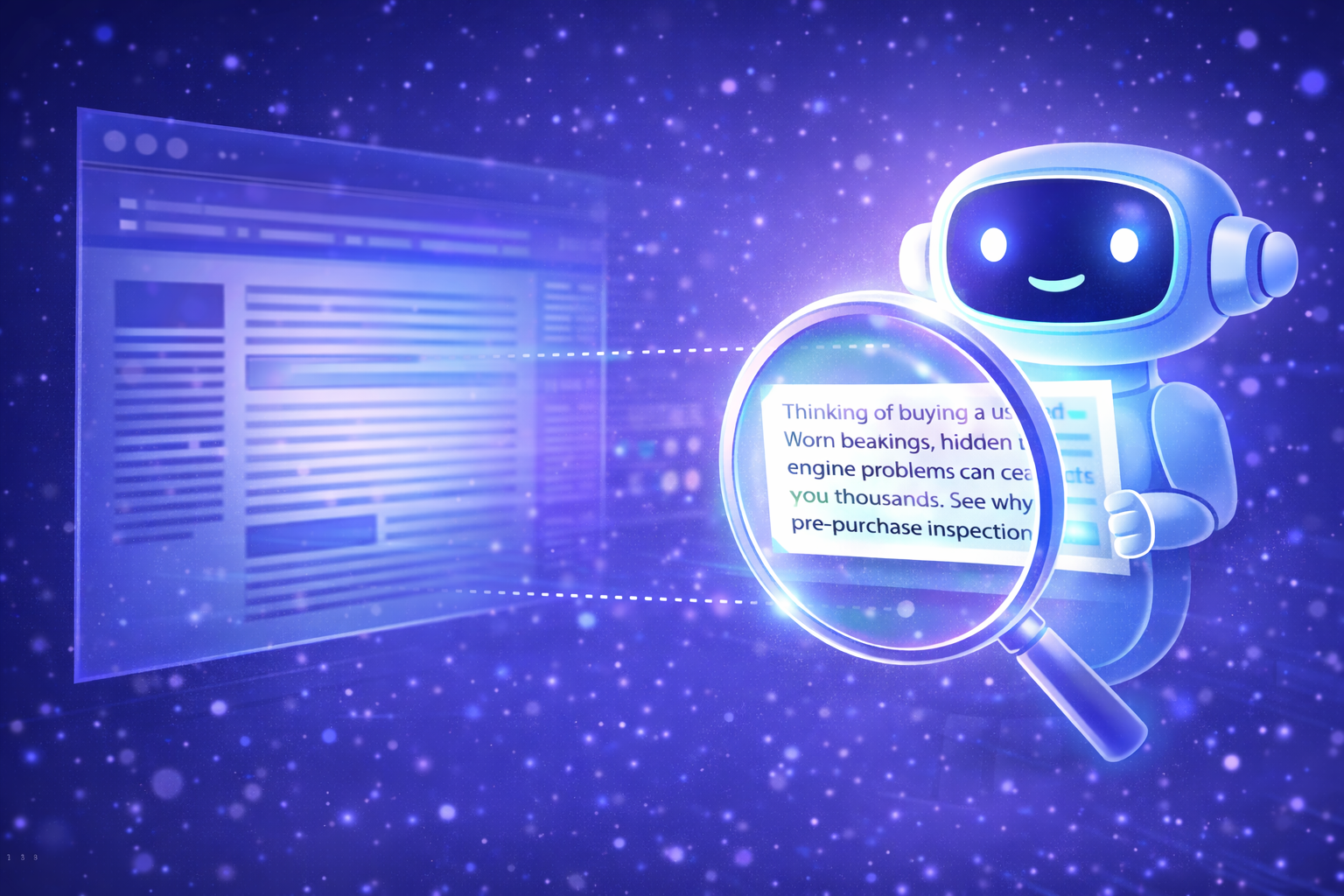
Most answer engines do not read your entire article before deciding whether to cite it.
They evaluate a small set of signals first — essentially your “pitch.”
Those signals are:
- URL
- Title
- Meta description
- Snippet-level content
In most cases, that’s it.
If those elements clearly communicate relevance, expertise, and usefulness, your content has a chance to earn a citation. If they don’t, the rest of the article often doesn’t matter.
This is also why more content isn’t automatically better. More content that provides true fresh expertise is what matters now.
Longer articles still win — especially for SEO — but for AEO, the finer details really need to be taken into account. You’re optimizing for how machines interpret your content as well as how humans browse it.
Why URL Structure and Language Matter More Than Ever
Another interesting shift: natural language URLs consistently outperform keyword-stuffed URLs in answer engines.
URLs written like real sentences (typically four to seven words) earn meaningfully more citations. The data we’ve seen suggests an uplift of roughly 11%.
Answer engines use URLs as an early signal of topical relevance. When they sound human, they perform better.
Freshness Is a Force Multiplier
Recency plays a bigger role in AEO than in traditional SEO.
Content published or meaningfully updated within the last 13 weeks is roughly 50% more likely to be cited by answer engines.
Fresh data wins. Updated insights win. Proprietary or opinionated metrics win even faster — because they become reference points that AI models “remember.”
This creates a flywheel effect:
Citations drive visibility.
Visibility leads to more citations.
Momentum compounds.
Where AI Is Pulling Answers From
Some sources punch far above their weight in answer engines:
- Reddit is currently the most cited source across most AI platforms. Depending on the engine, it accounts for roughly 2–5% of citations. The speed at which it can influence visibility is notable.
- YouTube is the second most cited source, especially inside Google AI Overviews, where it accounts for more than 6% of citations. Titles and descriptions matter enormously here, sometimes more than view count.
This doesn’t mean every brand needs to become a Reddit power user or a YouTube channel overnight. It does mean distribution strategy matters more than it used to.
Measuring AEO Success (It’s Not Just Traffic)
AEO performance doesn’t show up cleanly in most analytics platforms yet. Measurement looks different.
The most useful indicators right now include:
- Mentions in AI-generated answers
- Citations as a named source
- Referral traffic from answer engines
- Sentiment and positioning within responses
Tools like Profound and Ahrefs help surface this data by showing what people are asking, how brands appear in answers, where gaps exist, and how visibility changes over time.

What This Means for Marketers and Brands
A few practical takeaways:
- Strong SEO foundations still matter. They’re not optional.
- AEO rewards clarity, structure, and freshness more than sheer volume.
- Titles, descriptions, URLs, and snippets deserve as much strategic thought as the article itself.
- Shorter, focused, Q&A-style content can complement long-form blogs effectively.
- Speed matters — answer engines pick up new content faster than traditional search.
For most brands, the smartest move right now isn’t a wholesale pivot. It’s optimization first. Improve what already exists. Update what’s stale. Structure content so both humans and machines understand it.
The Bigger Shift to Watch
Long term, the biggest change isn’t tactical. It’s relational.
As AI agents become the primary interface between users and the web, marketers will spend less time trying to attract clicks — and more time earning trust through intermediaries.
That’s the real game of AEO.
And we’re still early.
If you need help planning your SEO or AEO strategy, tap the button below. We'd love to chat.
Thanks for reading, friend. Tap the button below if you're ready to discuss your next project.
Contact UsWritten by
Justin Kerby

Justin is the founder of Something Great Marketing, leading our Vancouver marketing agency. He specializes in content strategy, website design, and branding.

